Does Milk Tea Have Caffeine? How Much Is in a Boba Tea
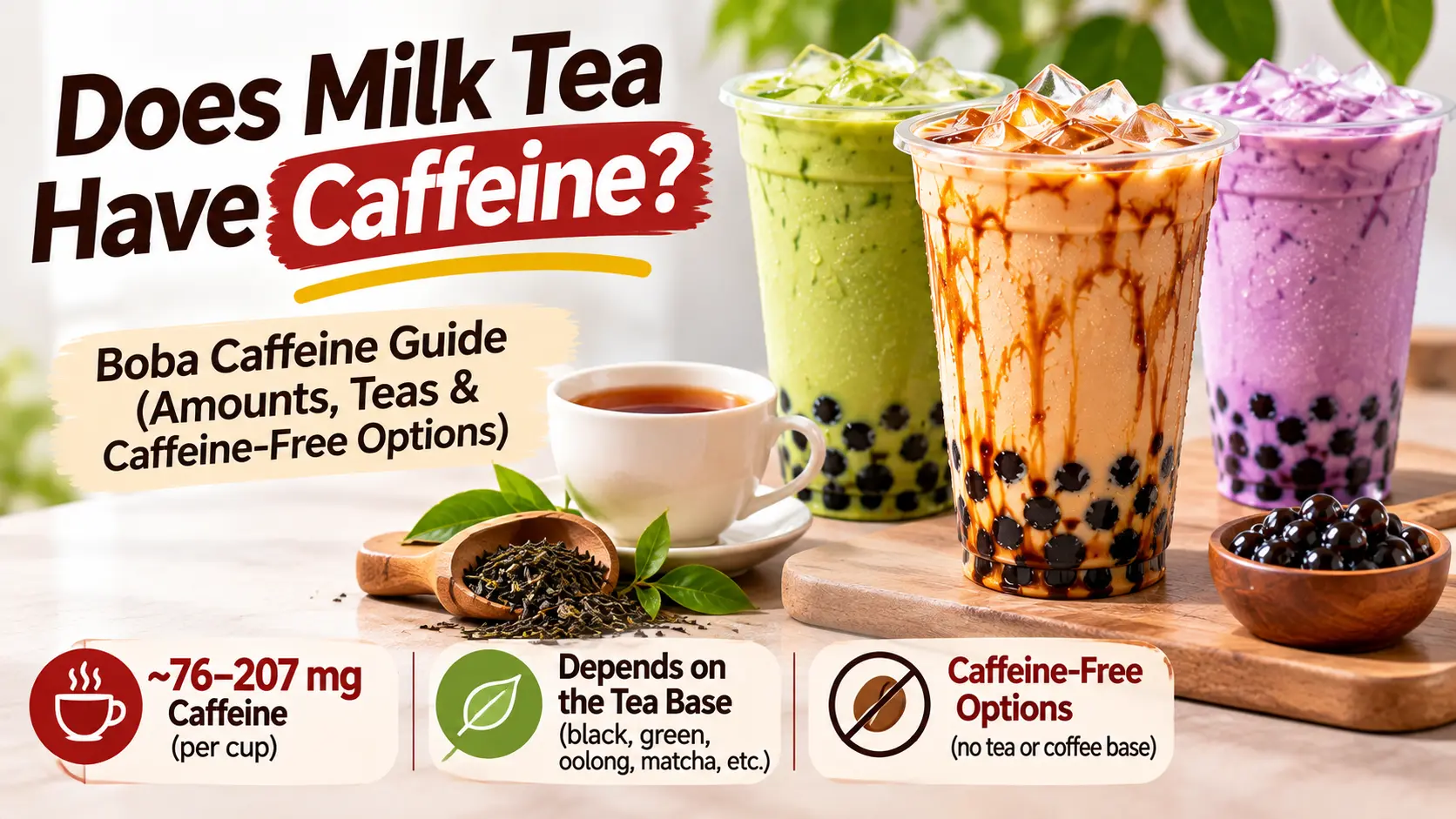
Yes. Most milk tea and boba tea contain caffeine because they are made with real brewed tea. The amount varies far more than most online charts suggest. Government lab tests of bubble milk tea have measured anywhere from about 76 mg to 207 mg of caffeine per cup, which can match or beat a regular cup of coffee.
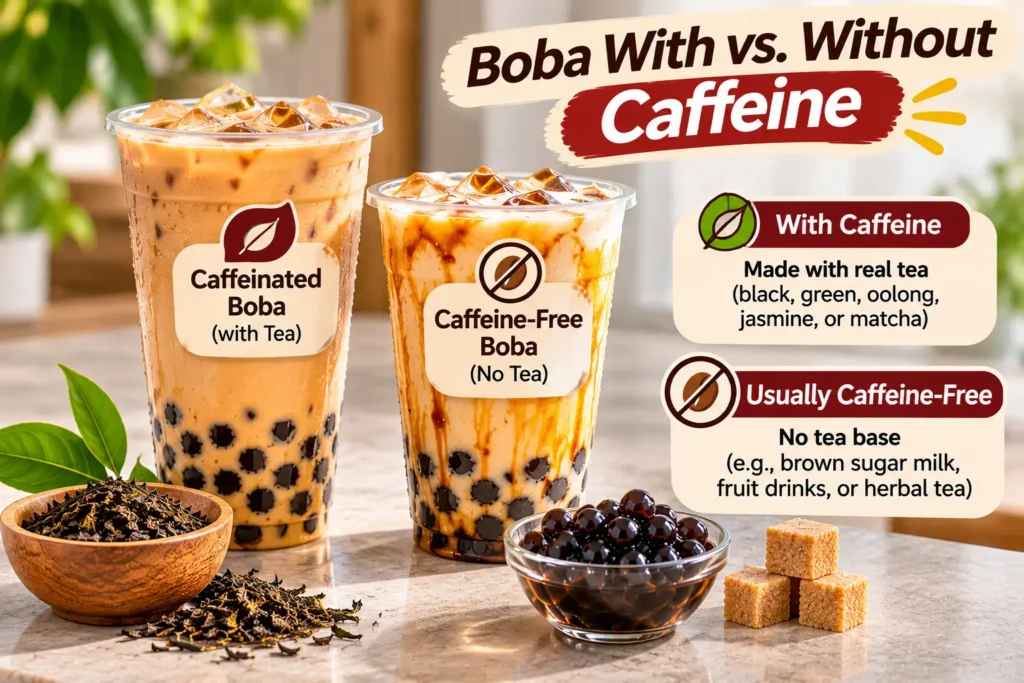
The tapioca pearls, milk, and sugar add no caffeine. Drinks with no tea base, like plain brown sugar milk with pearls, are usually caffeine-free.
This guide explains where the caffeine comes from, how much is realistic in a US-size boba, which drinks are lowest, and what we can confirm about HEYTEA milk teas.
Why Milk Tea Has Caffeine
The caffeine in milk tea comes from one place: the tea. Caffeine occurs naturally in the plants used to make tea, coffee, and chocolate, according to the FDA.
Black, green, oolong, and jasmine teas all come from the same tea plant (Camellia sinensis), so all of them carry caffeine. Matcha is powdered green tea, so it does too.
Here is how each part of a typical boba drink stacks up:
| Ingredient | Caffeine? | Notes |
|---|---|---|
| Black, green, oolong, or jasmine tea | Yes | The main source in almost every milk tea |
| Matcha | Yes | Whole powdered tea leaf |
| Thai tea | Yes | Made with black tea |
| Coffee or coffee jelly | Yes | Adds caffeine on top of the tea |
| Chocolate or cocoa | Small amount | Chocolate naturally contains some caffeine |
| Milk, creamer, or plant milk | No | Dilutes the tea but adds none |
| Sugar, syrups, brown sugar | No | Affects sweetness, not caffeine |
| Tapioca pearls | No | Made from cassava starch |
| Fruit, fruit jellies, aloe | No | Unless mixed into a tea base |
| Herbal “teas” (barley, chamomile, hibiscus) | Usually no. | Not from the tea plant |
So when you ask whether boba milk tea has caffeine, the real question is whether it has a tea or coffee base. Sharetea, a major US boba chain, puts it the same way: the caffeine in boba comes from the tea, and the tapioca pearls themselves are caffeine-free.
How Much Caffeine Is in Boba Tea?
A typical tea-based boba has roughly 75 to 200 mg of caffeine per cup, based on government lab tests of real shop drinks. That is much higher than the 25 to 70 mg figures that show up on many boba blogs.
What lab tests found
Only a few independent labs have tested boba shop drinks directly. Their results line up closely:
| Test | Drinks tested | Caffeine per cup |
|---|---|---|
| Macao Municipal Affairs Bureau and Consumer Council (reported 2020) | 12 bubble milk teas, including brown sugar, fresh milk, and green tea versions | 76.2 to 207.0 mg |
| Hong Kong Consumer Council and Centre for Food Safety (2013) | 10 Taiwanese-style milk teas | 100 to 160 mg (average 130) |
| Hong Kong Consumer Council (2013) | 30 Hong Kong café-style milk teas | 73 to 220 mg (average 170) |
| Hong Kong Consumer Council (2013) | 20 regular coffees with milk | 110 to 380 mg (average 200) |
The Macao report also noted that a single bubble milk tea can deliver more caffeine than a 473 ml can of energy drink, which it listed at about 160 mg.
These tests were done on shops in Asia, so US recipes and cup sizes may differ. They are still the best direct measurements available, and US chains generally do not publish caffeine figures for their drinks.
Why blog estimates run low
The low figures you see online usually come from a single 8 oz cup of plain brewed tea. A boba is a different drink:
- The cup is bigger. US boba cups commonly run 16 to 24 oz, two to three times a standard tea serving.
- The tea is often brewed strong. Shops brew concentrated tea so the flavor survives milk, ice, and sugar.
- Matcha uses the whole leaf. Powdered tea is stirred in rather than steeped and strained, so more of the leaf ends up in your cup.
A baseline by tea type
For plain brewed tea, the FDA lists about 71 mg of caffeine in 12 oz of black tea and 37 mg in 12 oz of green tea. Scaled to boba cup sizes, that gives a rough ceiling if the whole cup were tea:
| Tea base | 12 oz (FDA) | 16 oz cup | 24 oz cup |
|---|---|---|---|
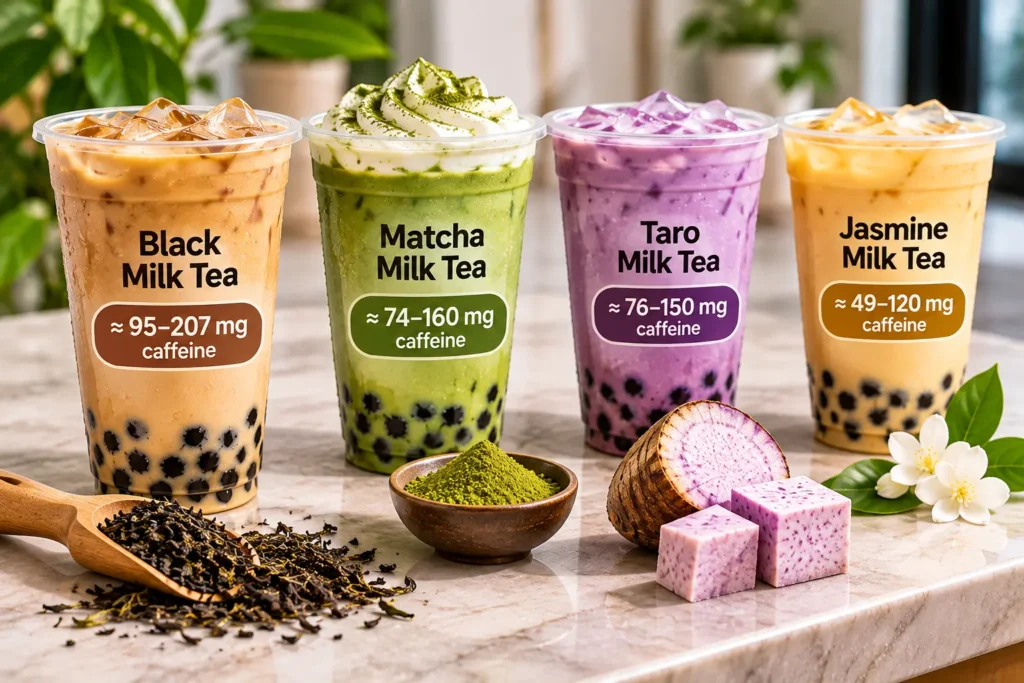
| Black tea (classic milk tea, Thai tea) | 71 mg | about 95 mg | about 142 mg |
| Green or jasmine tea | 37 mg | about 49 mg | about 74 mg |
Milk and ice take up part of the cup, which lowers the total. Strong brewing pushes it back up. That tug-of-war is why lab-tested cups land across such a wide range.
What changes the caffeine in your cup
- Tea base. Black tea and matcha usually carry more than green or jasmine tea.
- Cup size. A large has roughly 50% more of everything than a medium.
- Brew strength and steep time. Longer, stronger brewing extracts more caffeine.
- Milk and ice ratio. More milk or ice means less tea in the cup.
- Add-ins. Coffee, coffee jelly, or an extra tea shot adds more.
Milk Tea vs. Coffee, Soda, and Energy Drinks
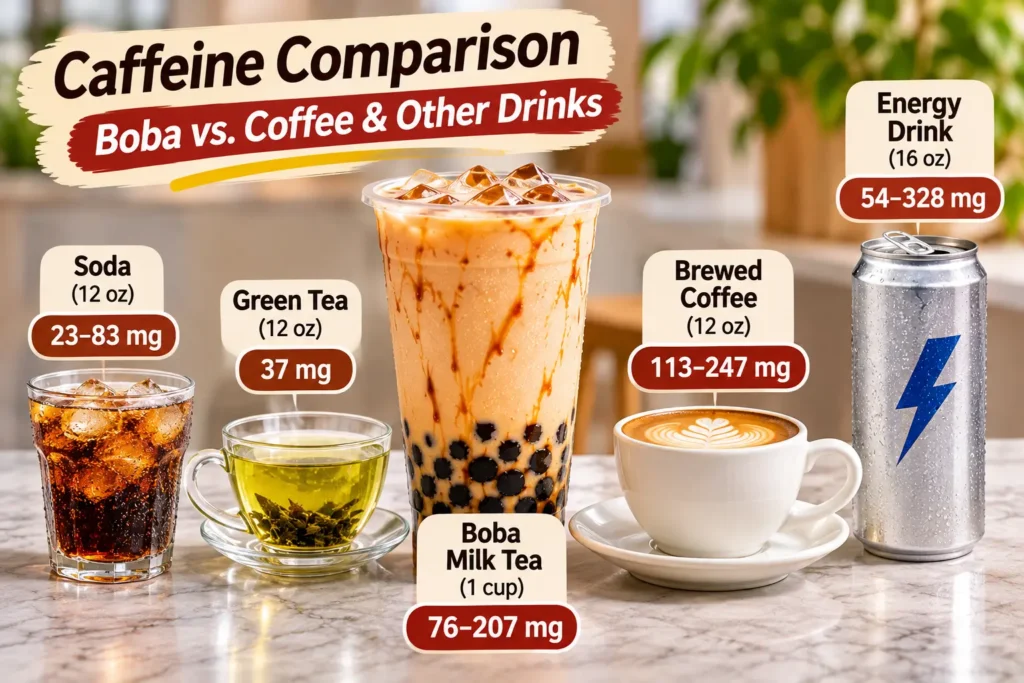
Cup for cup, a tea-based boba can carry about as much caffeine as a small coffee, and usually more than a can of soda.
| Drink | Serving | Caffeine |
|---|---|---|
| Caffeinated soft drink | 12 oz | 23 to 83 mg |
| Green tea | 12 oz | 37 mg |
| Espresso | 1 oz shot | 64 mg |
| Black tea | 12 oz | 71 mg |
| Bubble milk tea (lab-tested shop cups) | 1 cup | 76 to 207 mg |
| Taiwanese-style milk tea (lab-tested shop cups) | 1 cup | 100 to 160 mg |
| Brewed coffee | 12 oz | 113 to 247 mg |
| Energy drink | 16 oz | 54 to 328 mg |
Soft drink, tea, coffee, and energy drink figures are from the FDA. Espresso is from the Mayo Clinic. Milk tea figures are from the Macao and Hong Kong lab tests above.
Is milk tea a good alternative to coffee?
For caffeine, it can be. A large black milk tea may give you a similar lift to a regular coffee, and a green or jasmine milk tea will usually be gentler.
The bigger difference is sugar. A full-sugar boba is closer to a dessert than a morning coffee, so if you swap one for the other daily, choose a lower sugar level. Our HEYTEA nutrition guide lists sugar and calorie estimates by drink.
Boba Drinks With Little or No Caffeine
A boba is caffeine-free only when nothing in it comes from tea, coffee, or chocolate. The drink name doesn’t always tell you, so check the base.
| Drink | Caffeine | What to check |
|---|---|---|
| Brown sugar milk with pearls (no tea) | Usually none | Make sure it’s “milk,” not “milk tea.” |
| Fruit smoothies and slushes | Usually none | Some are blended with a tea base. |
| Yogurt or plain milk drinks | Usually none | Watch for added tea or coffee. |
| Herbal drinks (barley, hibiscus, chamomile) | Usually none | Not from the tea plant |
| Taro milk | Depends | “Taro milk” may be tea-free; “taro milk tea” has tea. |
| Fruit tea | Low to moderate | Usually made on a green or jasmine tea base |
| Chocolate or cocoa milk | Small amount | Chocolate contains some caffeine. |
| Decaf tea options | Small amount | Decaf is reduced, not zero. |
Decaf isn’t zero either. The FDA notes that decaffeinated coffee and tea still contain some caffeine, for example, 2 to 15 mg in 8 oz of decaf coffee.
Does HEYTEA Milk Tea Have Caffeine?
Most HEYTEA drinks do, because most are built on tea: milk teas, jasmine tea lattes, matcha drinks, and the fruit “Boom” drinks made with jasmine green tea. We could not find caffeine amounts published by HEYTEA for its US menu, and US restaurants are not required to disclose them (FDA).
Here is what HEYTEA’s own delivery descriptions show for its two signature boba drinks:
| Drink | HEYTEA’s description | Caffeine |
|---|---|---|
| Supreme Brown Sugar Bobo Milk Tea | Slow-cooked brown sugar bobo with real dairy milk tea. | Yes, from the tea |
| Supreme Brown Sugar Bobo Milk (Original) | Real dairy milk with slow-cooked brown sugar bobo, since 2012. | No tea listed, so it should be caffeine-free. |
If you want HEYTEA’s brown sugar boba without caffeine, the Original is the one to order. Ask at the counter to confirm, since recipes can change.
What one lab test found
In 2019, the Consumer Committee of Guangming District in Shenzhen, China, tested milk teas from 10 popular brands. It reported that HEYTEA’s Bobo Ice Milk Tea held caffeine equal to about 3.5 cans of Red Bull (China Daily).
That was a Chinese store and an older recipe, so it is not a measurement of today’s US drink. It does show that a tea-based HEYTEA boba can carry a meaningful dose of caffeine.
For the current HEYTEA lineup and prices, see our HEYTEA menu.
How Much Caffeine Is Too Much?
For most healthy adults, one tea-based boba a day sits well within US guidance, while two strong ones can approach the limit. Pregnant people and kids need to be much more careful.
| Who | Guidance | What it means for boba |
|---|---|---|
| Most adults | Up to 400 mg a day is not generally linked to negative effects (FDA). | Two lab-tested cups at the high end (about 207 mg each) would reach that limit on their own |
| Pregnant people | Less than 200 mg a day is considered moderate (ACOG Committee Opinion 462) | One strong milk tea could use up most or all of a day’s limit |
| Children and teens | The American Academy of Pediatrics discourages caffeine for kids; drinks with caffeine should be avoided under age 2 (FDA). | Choose a no-tea drink like brown sugar milk with pearls |
The Hong Kong Consumer Council made the point about kids directly. Using Health Canada’s limit of about 95 mg a day for a 12-year-old weighing 38 kg, it found that every Taiwanese-style milk tea in its test exceeded that amount (Hong Kong Consumer Council).
The FDA also notes that sensitivity varies from person to person. Signs you’ve had too much include:
- A racing heart or palpitations
- Jitters or anxiety
- Trouble sleeping
- Upset stomach or nausea
- Headache
How to Cut Caffeine Without Giving Up Boba
- Pick a no-tea base. Brown sugar milk, fruit smoothies, slushes, and yogurt drinks keep the pearls and drop the caffeine.
- Choose green or jasmine over black tea or matcha. Per the FDA, green tea carries about half the caffeine of black tea.
- Size down. A 16 oz cup has a third less tea than a 24 oz cup.
- Ask for less tea or more milk. Some shops may adjust the tea strength if you ask. The Hong Kong Consumer Council urged shops to offer milder milk tea on request.
- Skip coffee add-ins. Coffee jelly or an espresso shot stacks caffeine on top of the tea.
- Watch the clock. Have tea-based boba earlier in the day if caffeine keeps you up.
- Ask the shop. US restaurants don’t have to list caffeine, and the FDA encourages customers to ask whether a drink contains caffeine and how much.
Frequently Asked Questions
Does boba milk tea have caffeine?
Yes, if it is made with tea, which classic boba milk tea is. Lab tests of shop-made bubble milk tea measured about 76 to 207 mg per cup. Boba drinks made with only milk, fruit, or herbal bases are usually caffeine-free.
Do tapioca pearls have caffeine?
No. Tapioca pearls are made from cassava starch and contain no caffeine. All the caffeine in a boba comes from the tea, coffee, or chocolate in the drink.
Does Thai tea boba have caffeine?
Yes. Thai tea is made with black tea, so a Thai milk tea carries caffeine much like a classic black milk tea.
Does taro milk tea have caffeine?
It depends on the shop. Taro milk made with only taro and milk is usually caffeine-free, but many shops make taro milk tea with a black or green tea base. Check the menu wording or ask.
Does matcha boba have more caffeine than regular milk tea?
Often, yes. Matcha is the whole tea leaf ground into powder, so you drink all of it instead of a steeped infusion. The exact amount depends on how much powder the shop uses.
Does milk cancel out the caffeine?
No. Milk adds no caffeine and doesn’t remove any. It only takes up space in the cup, so a milkier drink has less tea in it.
Does boba tea have more caffeine than coffee?
Usually less, but not always. The FDA lists 113 to 247 mg in 12 oz of brewed coffee, while lab-tested bubble milk teas ranged from about 76 to 207 mg per cup. A large, strong black milk tea can match a small coffee.
Is boba with decaf tea caffeine-free?
No. Decaf tea and coffee still contain small amounts of caffeine, according to the FDA. If you need zero caffeine, pick a drink with no tea or coffee at all.
Can kids drink boba tea?
Pediatric experts discourage caffeine for children, so tea-based boba isn’t a good choice for kids. A brown sugar milk with pearls or a fruit smoothie with boba gives them the same fun without the caffeine.