What Are Tapioca Pearls? The Real Story Behind Boba (and HeyTea’s Bobo)
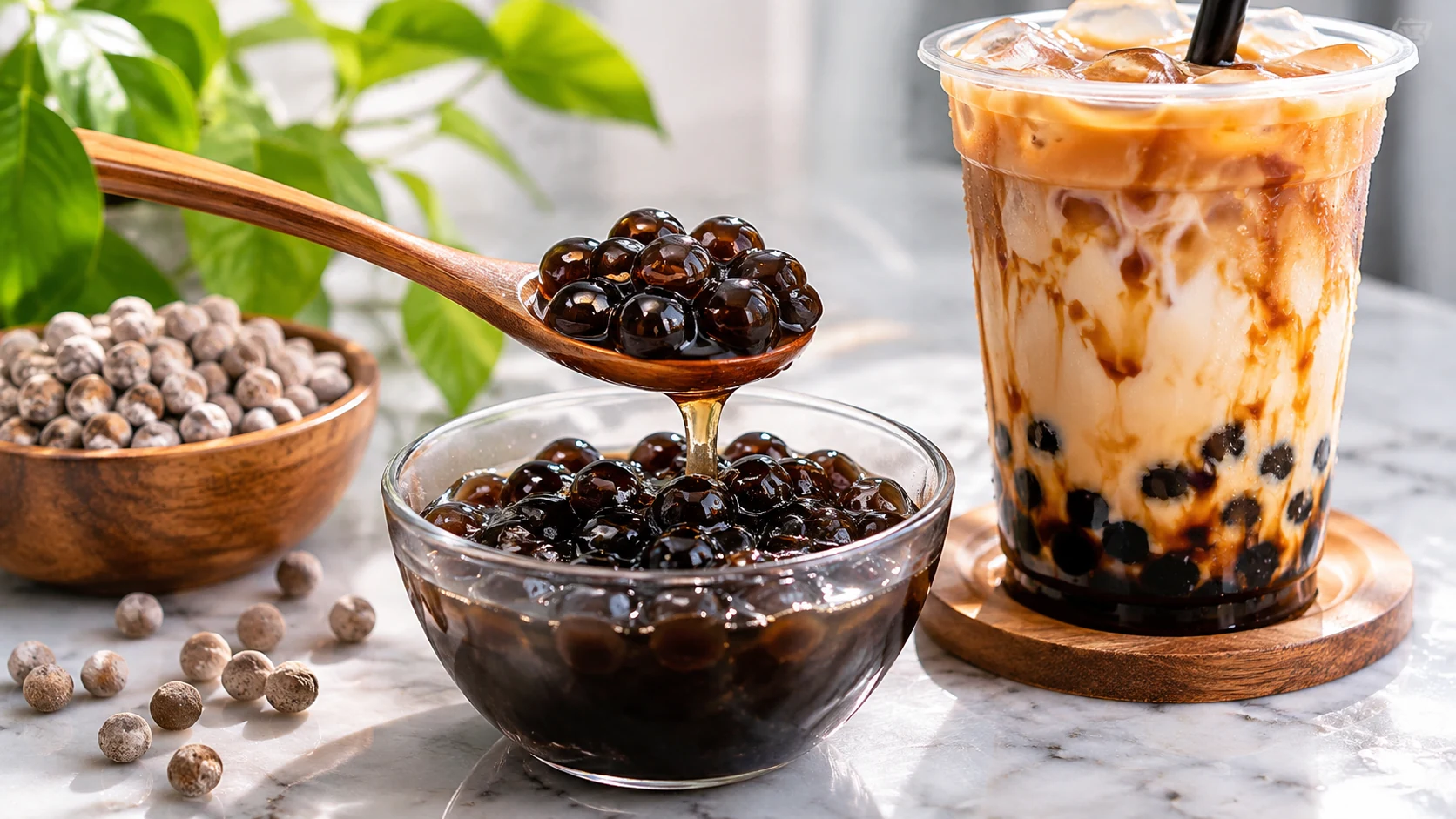
Tapioca pearls are the dark, chewy spheres at the bottom of a bubble tea cup, and they are the reason the drink comes with an extra-wide straw. They are made from cassava starch, they taste very little on their own, and they turn hard if you leave them in the fridge overnight.
This guide explains what boba pearls actually are, the different types you will see on US menus, how shops cook them, what they add in calories, and how HeyTea’s slow-cooked brown sugar bobo fits into the picture.
Quick answers
- Made from: tapioca starch, extracted from the root of the cassava plant
- Flavor: mostly neutral; the taste comes from the sugar syrup they are cooked or soaked in
- Texture: soft and slippery outside, chewy and springy inside
- Calories: about 358 per 100 g of dry pearls, almost all from carbohydrate (USDA)
- Caffeine: none; any caffeine in your cup comes from the tea
- Gluten: tapioca starch is naturally gluten-free, but flavored pearls and syrups can contain other ingredients
What Are Tapioca Pearls?
Tapioca is a starch taken from the cassava root, a starchy tuber that is a staple food in many parts of the world. According to WebMD, tapioca is made by washing and squeezing the cassava root, and the starchy pulp left from that process is tapioca. That is different from cassava flour, which is made by peeling, drying, and grinding the whole root.
To make pearls, the starch is formed into small balls and dried. At the shop, the dry pearls are boiled until they swell, turn glossy, and develop their chew. Bossen, one of the largest boba suppliers in the US, lists its large pearls at about 8.5 mm across before cooking and around 10 mm after.
So, what is tapioca boba? It is simply a cooked tapioca pearl served in a drink. When people say “boba” in the US, they usually mean these pearls, and often the whole drink too.
Is Boba Tapioca? Boba, Pearls, and Bobo Explained
Classic boba is tapioca. Whether someone searches for pearl boba, boba pearls, or pearls boba, they are asking about the same ingredient: cassava starch rolled into chewy balls.
The confusion comes from the fact that “boba” has become a catch-all word for anything round in a bubble tea cup. Some of those toppings are not tapioca at all.
| Name on the menu | What it usually means | Tapioca? |
|---|---|---|
| Boba, pearls, tapioca, boba tea pearls | Classic chewy tapioca pearls | Yes |
| Pearl milk tea / pearl tea | Milk tea served with tapioca pearls | Yes |
| Bobo (HeyTea) | HeyTea’s own name for its brown sugar tapioca pearls | Yes |
| Crystal boba / agar boba | Jelly-style balls made with konjac and gums | No |
| Popping boba / popping pearls | Juice-filled spheres with a thin gel skin | No |
| Sago | Small pearls made from sago palm starch, though some shops use the word for mini tapioca | Sometimes |
HeyTea’s menus pair the English word “bobo” with the Chinese 波波. Its Malaysian delivery menu, for example, lists the add-on as “Brown Sugar Bobo 慢熬黑糖波波,” which translates roughly to slow-simmered brown sugar bobo.
Where Bubble Tea Tapioca Pearls Came From
Bubble tea started in Taiwan in the 1980s, and who invented it is still disputed. Britannica places its origin in Tainan in the mid-1980s, and the Taipei Times reports that two teahouse chains claim the idea.
According to the Taipei Times, Hanlin Tea Room in Tainan says its founder, Tu Tsung-ho, came up with the drink in 1986 after spotting white tapioca balls at a local market. Chun Shui Tang in Taichung credits an employee, Lin Hsiu-hui, who added tapioca to iced tea a year or two later. Sources differ on whether that happened in 1987 or 1988.
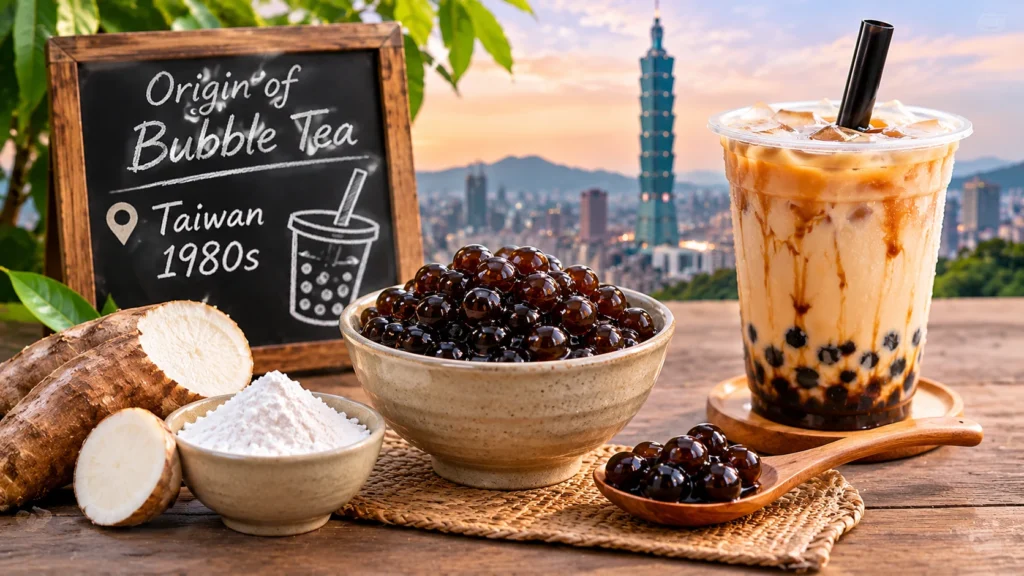
Neither claim has fully settled the debate. What both stories agree on is the key ingredient: tapioca pearls in cold tea.
Why Are Most Boba Pearls Black?
Plain tapioca starch is white, and cooked white pearls turn translucent. The dark color most people associate with boba comes from brown sugar. The Taipei Times notes that Hanlin still lets customers choose between its original white tapioca balls and the more common black version made with brown sugar.
Brown sugar does more than change the color. It gives the pearls a light caramel sweetness, which is why black pearls taste noticeably different from clear ones even though the starch underneath is the same.
What Do Tapioca Pearls Taste Like?
On their own, tapioca pearls taste like very little. The starch is neutral, so nearly all of the flavor comes from what the pearls are cooked or soaked in. Bossen’s own recipe has shops sweeten pearls after cooking with fructose, honey, or raw cane sugar, and brown sugar pearls pick up a deeper, toffee-like taste.
Texture is the real reason people order them. A well-cooked pearl has:
- A smooth, slightly slippery surface
- A soft outer layer that gives way easily
- A dense, springy center that pushes back when you bite
Freshness changes everything. Bossen recommends using cooked pearls within four hours, because starch causes them to turn soft and mushy over time. Refrigerating them has the opposite effect and makes them firm and hard, which is why suppliers warn against chilling cooked pearls.
HeyTea’s brown sugar bobo sits at the softer end of the scale. One Singapore reviewer on Burpple described the brand’s pearls as “extremely soft,” comparing them to marshmallows.
Types of Boba Pearls
Here are the types of boba pearls you are most likely to see in US bubble tea shops, including the ones that are not tapioca at all.
Type | Main ingredients | Texture | Preparation | Tapioca? |
|---|---|---|---|---|
Black tapioca pearls | Tapioca starch, brown sugar | Chewy, bouncy | Boiled, then rested and sweetened | Yes |
White or clear tapioca pearls | Tapioca starch | Chewy, translucent when cooked | Boiled | Yes |
Mini tapioca pearls | Tapioca starch | Softer, smaller bite | Shorter cook (about 10 minutes plus a 5-minute rest for Bossen’s small pearls) | Yes |
Slow-cooked brown sugar pearls | Tapioca pearls simmered in brown sugar syrup | Very soft, sweet throughout | Long simmer in syrup | Yes |
Crystal boba (agar boba) | Konjac, carrageenan, sugar syrups, gums | Jelly-like, firmer chew | Ready to serve; refrigerate after opening | No |
Popping boba | Fruit juice, sodium alginate, calcium salts | Thin skin that bursts | Ready to serve | No |
Sago | Sago palm starch (sometimes mini tapioca sold as “sago”) | Small, soft, slippery | Short boil | Sometimes |
A few details worth knowing:
- Crystal boba is often marketed as “agar boba,” but Bossen’s ingredient list shows it is built mainly on konjac powder, carrageenan, and several gums. It needs no cooking, and Bossen recommends refrigerating it after opening and finishing it within a week.
- Popping boba is made through spherification. A juice mixed with sodium alginate meets a calcium solution, and the reaction forms a thin gel skin around the liquid.
- Sago comes from the starchy pith of sago palms, while tapioca comes from cassava root. The two look alike and are often swapped on menus, so the ingredient list is the most reliable way to tell them apart. HeyTea uses sago in drinks like its Coconut Mango Boom.
How Shops Cook Tapioca Pearls for Bubble Tea
Most boba shops in the US start with dry pearls from a supplier and cook them in batches throughout the day. Bossen’s published guidance for its large pearls is a good snapshot of the standard method:
- Bring water to a boil, using roughly 600 mL of water for every 100 g of dry pearls.
- Add the pearls slowly and stir right away so they do not stick together.
- Cook for about 30 minutes, stirring occasionally.
- Let the pearls rest off the heat (Bossen suggests about 35 minutes for large pearls).
- Drain, then coat in a sweetener such as fructose, honey, or cane sugar syrup.
- Hold at room temperature and use within four hours.
That four-hour window explains why good shops cook small batches often, and why some locations occasionally run out of pearls during busy hours. It is also why bubble tea is best finished soon after you buy it. A cup left in the fridge overnight will not have the same pearls the next day.
Making Boba Pearls at Home
Home cooks can follow the same steps with store-bought dry pearls. Quick-cook pearls sold in Asian grocery stores are faster, often ready in 5 to 10 minutes, but always follow the timing printed on the bag because it varies by brand and size. Cook only what you will drink that day, and skip the refrigerator for leftovers.
HeyTea’s Brown Sugar Bobo: How It Differs
HeyTea is best known for cheese tea and fruit teas, but its tapioca pearls have their own following. The brand calls them bobo, and its menu copy describes them in more detail than most chains do.
Slow-Cooked and Made Daily
On HeyTea’s delivery menus in Singapore and Malaysia, the Brown Sugar Bobo add-on is described as slow-cooked for 65 minutes each time and prepared daily, with the brown sugar syrup soaking into the pearls for a soft, chewy texture that the brand says is different from regular pearls. The Malaysian menu also states that the bobo is made from tapioca naturally ripened over 270 days.
That long simmer is why HeyTea’s pearls are sweet all the way through rather than just coated in syrup. It also means the pearls bring their own sugar to the cup.
The Drinks Built Around Bobo
The signature pearl drink is the Supreme Brown Sugar Bobo Milk (Original), which HeyTea’s menus describe as real dairy milk with slow-cooked brown sugar bobo, labeled “Since 2012.” Other bobo drinks include versions with milk tea, oat milk, and a cheese cloud topping. HeyTea’s Bobo Milk Tea, for instance, pairs the pearls with its Red Blossom milk tea.
HeyTea opened its first US store on Broadway in Midtown Manhattan in December 2023, as reported by World Coffee Portal. Coverage of its later US openings lists the Supreme Brown Sugar Bobo Milk Tea and a lower-priced classic version on the American menu. Check our HeyTea Menu USA page for current drinks and prices near you, since availability changes by location.
The “BOBO Universe” and the Yayoi Kusama Collaboration
HeyTea treats the pearls as part of its brand identity, not just a topping. In November 2024, the company partnered with artist Yayoi Kusama under the theme “Adding a Touch of BOBO to the World,” linking Kusama’s polka dots to HeyTea’s round bobo pearls. Marketing-Interactive reported that the launch included seven BOBO tea products, among them the return of the Supreme Brown Sugar BOBO Milk.
The campaign reached US stores in January 2025, with Kusama-themed packaging and an in-store promotion that offered a free serving of Brown Sugar BOBO toppings.
Ordering Tips for HeyTea’s Bobo
- Lowering the sugar level won’t change the pearls much. The bobo is cooked in brown sugar ahead of time, so the sweetness setting mainly affects the milk or tea around it.
- Try it in a black tea or milk tea base if you want the classic boba experience. Fans of a plain HeyTea Black Tea Latte can ask about adding bobo as a topping where it is offered.
- Drink it soon. Like all tapioca pearls, bobo is at its best within the first hour or so after you get your cup.
Tapioca Pearl Nutrition and Calories
Tapioca pearls are almost pure starch. The USDA’s FoodData Central database (entry “Tapioca, pearl, dry,” FDC ID 169717) gives these values:
| Nutrient | Per 100 g dry pearls | Per 30 g dry portion* |
|---|---|---|
| Calories | 358 kcal | about 107 kcal |
| Carbohydrates | 88.7 g | about 26.6 g |
| Sugars | 3.4 g | about 1 g |
| Fiber | 0.9 g | about 0.3 g |
| Protein | 0.19 g | under 0.1 g |
| Fat | 0.02 g | under 0.1 g |
| Sodium | 1 mg | under 1 mg |
*30 g of dry pearls is the serving size Bossen lists for its large tapioca pearls. The per-portion figures are calculated from the USDA values.
Keep in mind that these numbers describe plain pearls before any sweetener. In a real drink, the syrup the pearls are soaked in, the milk, and any cheese cloud topping all add to the total, which is why a brown sugar boba milk tea usually lands among the higher-calorie drinks on any menu. For drink-by-drink estimates, see our HeyTea Nutrition Menu.
The pearls themselves contain no caffeine. If your boba drink has a buzz, it comes from the black tea, jasmine tea, or matcha in the base. A pure HeyTea Jasmine Tea with no sugar and no toppings sits at the opposite end of the calorie scale.
Are Tapioca Pearls Safe and Gluten-Free?
For most people, yes, with a few points worth knowing.
Gluten. Tapioca starch comes from a root, not a grain, so it is naturally gluten-free. Flavored pearls, syrups, and some toppings can include other ingredients, so people with celiac disease should check labels or ask staff before ordering.
Cassava processing. Raw cassava root naturally contains cyanide compounds. WebMD notes that the tapioca sold in the US contains only trace amounts that should not cause harm, because the starch has been processed.
Choking risk for young children. Pearls are firm, round, and pulled up quickly through a wide straw. Bossen’s packaging warns against giving tapioca pearls to children under 5, and its crystal boba carries a similar choking warning. Taking smaller sips is a good habit for adults too.
Sugar. The pearls themselves are low in sugar, but brown sugar pearls and the syrups they sit in are not. If you are watching your intake, the drink base and toppings matter more than the starch.
Frequently Asked Questions
Want to see which HeyTea drinks come with bobo right now? Browse the full HeyTea menu, or explore more in our HeyTea guides.
heyteamenuu.com is an independent informational website and is not affiliated with HeyTea. Menu items, prices, and availability vary by location.